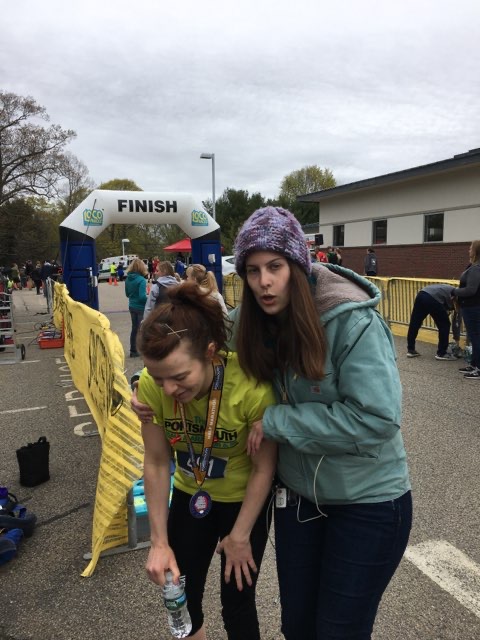
Can you tell that woman on the left is super relieved to have just run her first-half marathon? Yep, I thought so. I ran that race right around this time in May a few years back, and it honestly and truly was a rewarding experience. The first time I ran for an hour, I was blown away! But when I thought about half marathons, 13 miles, I definitely didn’t think that was something I could ever do. I really do enjoy being proven wrong though!
I was riding a shuttle to a 10K (about 6.26 miles) a year or so prior to this race when a fellow runner shared something with me that helped me break the mentality that I could never run a half-marathon. A seasoned runner, she said she had thought the same thing, how could I ever do that? And someone had explained to her, it happens one race at a time. She shared with me that to get to a half-marathon, you start small. You run 5K’s, get outdoor races under your belt, then move on to and train for longer races. From the 5K’s, you move on to 7K’s (a far less common 4.5 miles, but you can find them!), then onto 10K’s, progressing onto 10 Milers, and then you are right on the edge of the being able to do those 13.26 half-marathon miles. That is one of the things I enjoy most about running, with training, patience, and persistence, you can build yourself up to cover greater and greater distances, and do it better each time.
When thinking about a half-marathon, training and preparation is key! In order to have a successful race day, you need to put the time and intentionality in beforehand, and you will be incredibly glad you did. For my training, I used a Half-Marathon Training Plan that I found through Nike, which you can access by clicking here. This plan helped me to have a set running schedule during the week, and progressively built up my endurance each week. With varying types of runs, distances, and training days built into it, this running plan increased my stamina and consistency as I went through training. The plan also builds in days for rest and strength training, essential balances to the high miles clocked each training week. A running plan will help provide you with a set routine as you train, and most start about 14 weeks before race day. This allows you to get a solid start to training, and help ensure you are equipped, prepped, and ready for race day.
You can certainly find other training plans online, but no matter which one you choose, it is recommended that you start training for your race at least 12 weeks before race day. This will provide you time to prepare your body for the demands of a half-marathon, and lower your risks of injury, fatigue, or muscle failure on race day. Rest and recovery are just as crucial to your training as your actual runs, and never forget this! During training times, you are putting a continuous and high demand on your body, and you have to give to your body even more than you take from it. Do your very best to sleep 8 hours each night, and allow yourself at least 1-2 days of full rest (no running, strength, or hard exercise) each week. This will help your muscles to recover properly, prevent you from burning out, and enable you to have the best training days possible. If you have days you need to scale back a bit or take an extra rest day, do it! Consistency is essential to great training, but what your body needs each day will always be most critical. Take care of yourself when you train, it is a long term investment that will pay off beautifully when you come to the end of it.
For the sake of length, I will create multiple posts that speak to tips for running a half marathon, from the first steps of training to what to expect on race day. Be sure to keep a look out for my next post when I will get into the healthiest ways to fuel your training and eat for race day!
 The Reasonable Runner
Leave a comment